Crag Bank Art
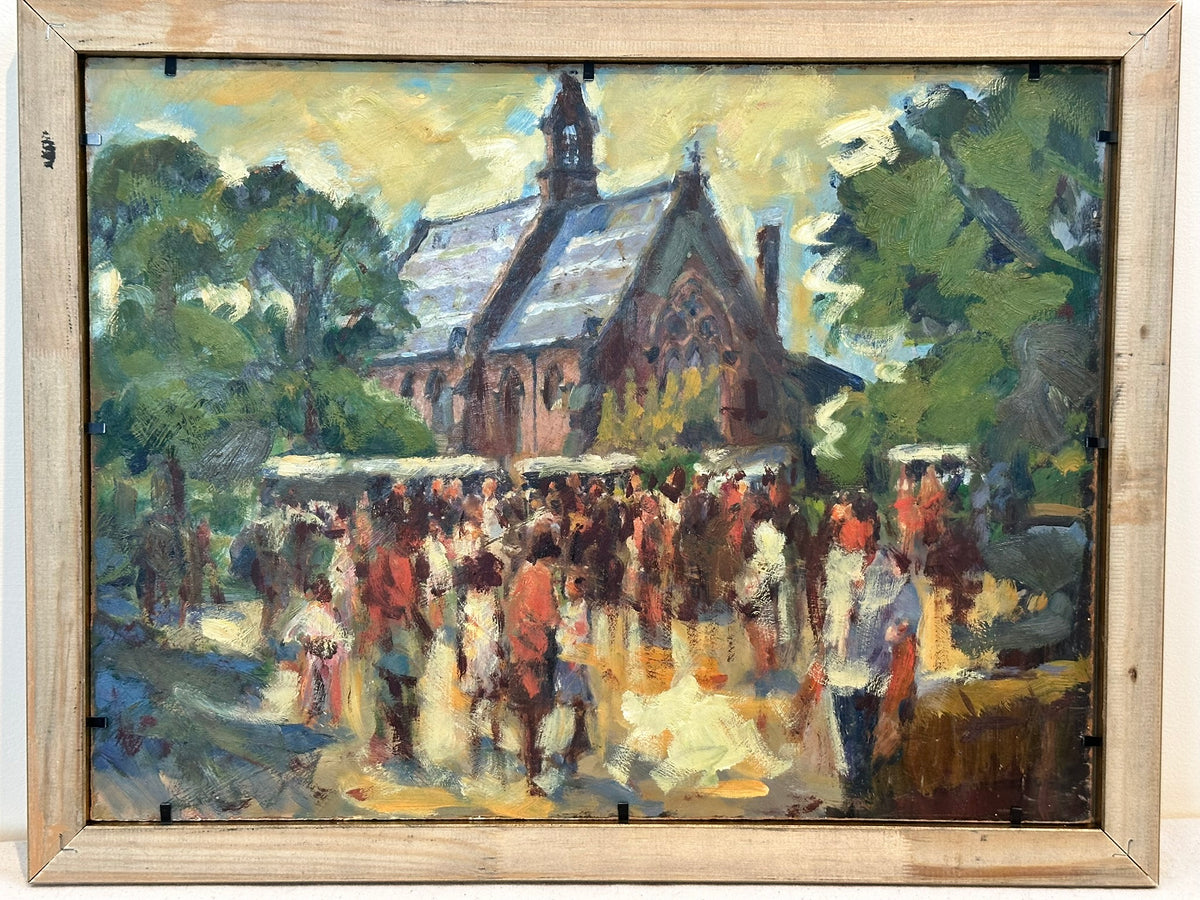
Keith Gardner RCA (1933-2025) - Boats and Buildings, Chester / People Outside St John's Church, Frankby
Keith Gardner RCA (1933-2025) - Boats and Buildings, Chester / People Outside St John's Church, Frankby
Couldn't load pickup availability
Share
A highly appealing double-sided oil on board by Keith Gardner RCA, bringing together two characteristic north-west subjects: a lively waterside scene in Chester and a figure-filled view outside St John the Divine at Frankby on the Wirral.
The principal face, Boats and Buildings, Chester, is signed GARDNER lower left. Boats occupy the foreground, with the architecture of Chester rising beyond. Gardner handles the scene with the immediacy associated with his small plein-air oils, using brisk strokes and blocks of colour to capture the character of the place rather than pursuing a highly finished studio treatment.
The reverse, People Outside St John's Church, Frankby, depicts figures gathered outside the church. It is a particularly engaging subject, combining architecture, landscape and figures in a location Gardner is known to have painted repeatedly.
Details
Artist: Keith James Gardner RCA (1933-2025)
Title: Boats and Buildings, Chester / People Outside St John's Church, Frankby
Medium: Oil
Support: Board, painted on both sides
Signature: Signed GARDNER lower left on the Chester side; Frankby side unsigned
Artwork size: 29.5 × 40 cm (11.6 × 15.7 in)
Frame size: 35 × 45.5 cm (13.8 × 17.9 in)
Condition: Very good condition
Provenance: The Estate of Keith Gardner
Chester and Frankby
Both sides of this painting sit comfortably within Gardner's documented artistic territory. Gardner was closely associated with the Wirral and North Wales, and the Royal Cambrian Academy recorded that he specialised in small oil panels painted directly on location around these areas.
Frankby was clearly a recurring subject. Other documented Gardner paintings include Animals at Frankby, Horses and Girls at Farm Gate, Frankby and Cattle at Frankby, demonstrating his sustained interest in the village and its surrounding countryside.
The church depicted here is identified as St John the Divine, Frankby, the parish church on Frankby Road. The inclusion of figures outside the building gives the reverse painting an appealing narrative quality that distinguishes it from Gardner's more numerous pure landscapes.
The Chester composition provides a contrasting urban and waterside subject. Boats, buildings and figures were all recurring elements within Gardner's work, and the two sides together give an unusually broad view of his local subject matter.
A Double-Sided Painting
Both compositions are painted on the same board. The Chester side carries Gardner's signature, GARDNER, at the lower left. The Frankby composition on the reverse is unsigned. The listing therefore records the location of the signature precisely rather than suggesting that both sides are individually signed.
The double-sided format also has particular relevance to Gardner's working method. His reputation was built substantially around compact oil panels painted rapidly and directly from the subject, and a board used on both faces is entirely consistent with that economical, location-based practice.
About the Artist
Keith James Gardner RCA (1933-2025) was born in Liverpool and studied at Liverpool Art School and the Laird School of Art in Birkenhead.
He was elected an associate member of the Royal Cambrian Academy in 1977 and subsequently became a full Academician. Gardner worked as a full-time painter from 1975 to 1985 before spending thirteen years at the Williamson Art Gallery in Birkenhead.
The Royal Cambrian Academy described Gardner as specialising in small “on the spot” oil panels painted around North Wales and the Wirral. His paintings frequently depict boats, beaches, harbours, villages, churches and countryside, handled with direct and economical brushwork. Chester and Frankby sit squarely within his established geographical territory, while the two contrasting compositions show both the urban and rural strands of his practice.